Project Re:Form
The form that 2.5 million people used.
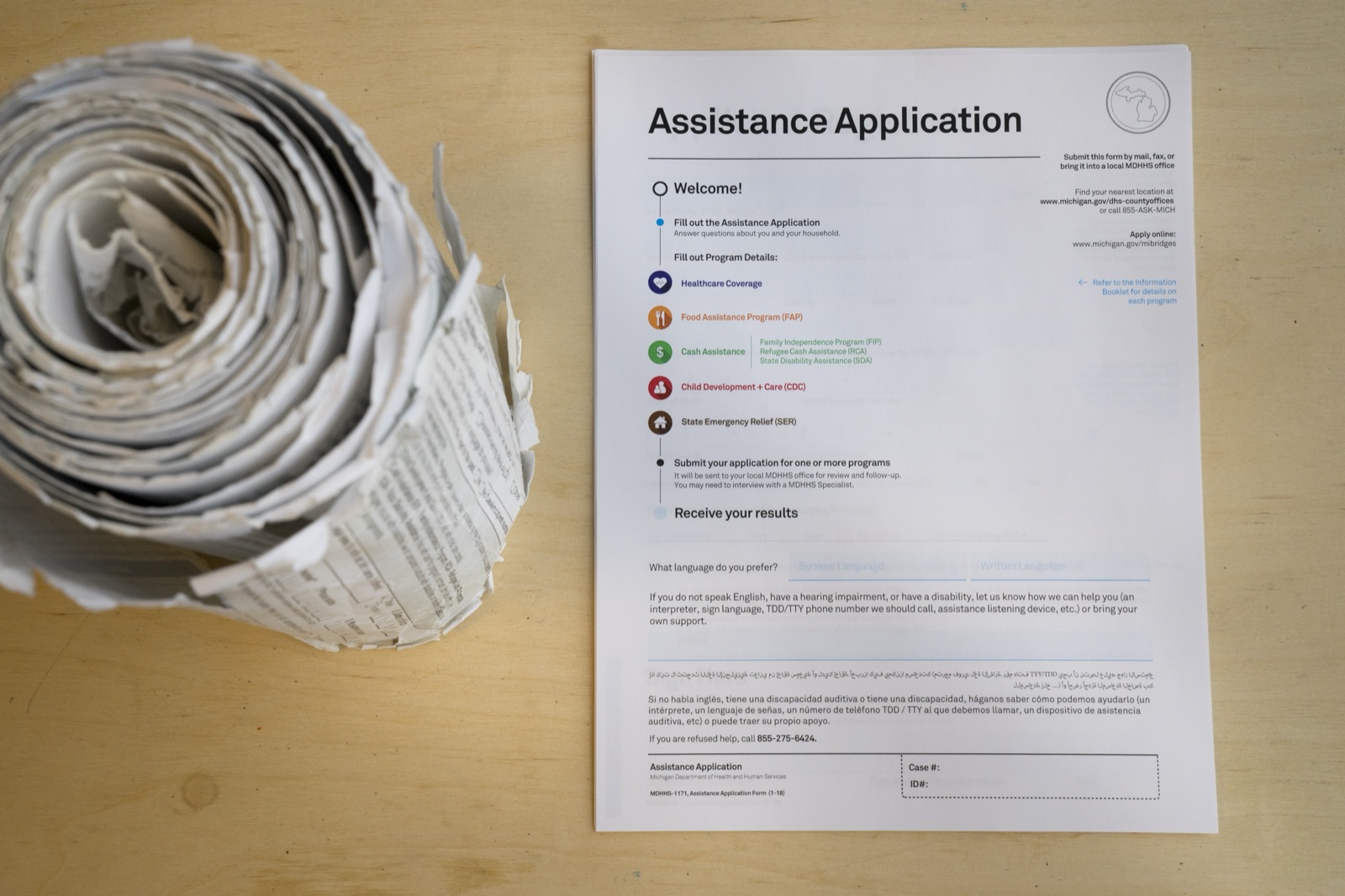
In 2015 we got our hands on Michigan’s application for public benefits — the form 2.5 million residents used each year to access food assistance, healthcare, childcare, and emergency relief. It was 40+ pages long, more than 1,000 questions, 18,000 words. The longest application of its kind in America. It included questions like “What is the date of conception of your children?”
By 2019 it had been redesigned, piloted, approved by both CMS and USDA, trained across 5,000 staff in 100+ offices, and rolled out statewide. The new version cut the words and questions by 80% and the page count from 40+ to 18; applications came in 94% complete (up from 72%), and processing times dropped significantly. Caseworkers folded their leftover stacks of the old form into origami hats and paper birds.
Harvard Kennedy School recognized the work as one of the top 25 innovations in American government.
The lesson from Re:Form that has shaped everything since: nothing moves without a concrete proof point. Telling a state agency about “human-centered design” meant nothing. Holding up a 40-page form and saying this could be different changed the conversation.
- 80% fewer words and questions; 40+ pages cut to 18
- 94% completion rate (up from 72%)
- Rolled out statewide across 100+ field offices
- Trained 5,000+ staff
- Top 25 Innovation in American Government — Harvard Kennedy School
- Executive Office of the President Michigan named the federal benchmark to 'deliver at the speed of need'
- The New York Times How Tech Is Helping Poor People Get Government Aid
- Bridge Michigan Michigan tames a 18,409-word testament to bureaucracy run amok
- Government Technology Top 25 Doers, Dreamers & Drivers: Team Civilla
- Core77 Design Awards Design for Social Impact winner: Project Re:Form
- International Design Awards Gold, Design for Society: Project Re:Form
- GOV Design Awards 2018 Government experience winner: Project Re:Form
- Michigan Public (NPR) How Michigan used human-centric design to make its public benefits process more user friendly